
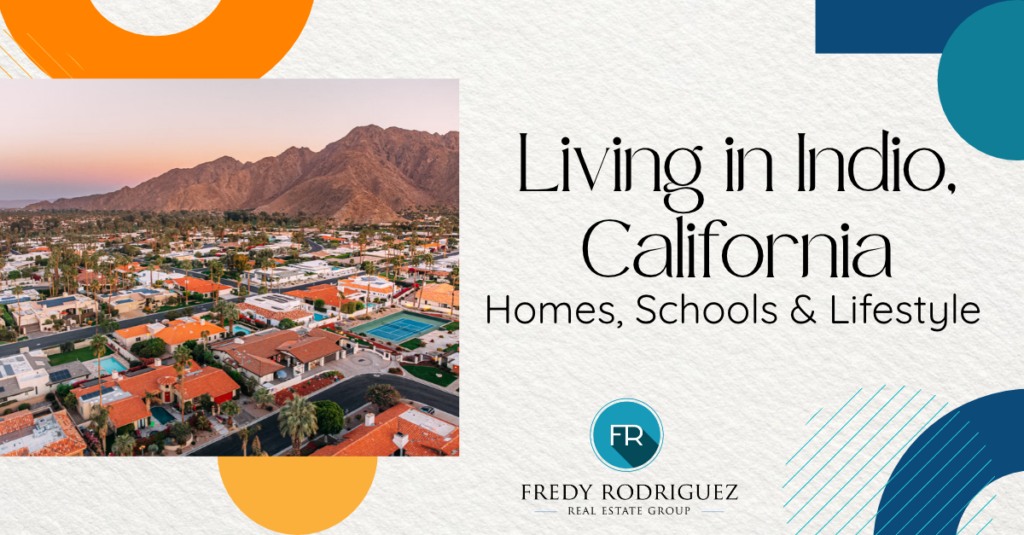
Why Families Are Choosing Indio: New Homes, Schools, Events, and Commute Considerations
When people think about living in Indio, California, they often think about the Coachella and Stagecoach music festivals, warm desert weather, and the city’s growing reputation as a destination for entertainment.
But there’s another side to Indio that deserves attention.
Beyond the festivals, Indio is a city where new neighborhoods are taking shape, public spaces are being improved, and housing options continue to expand.
For people considering a move to the Coachella Valley, Indio offers an interesting combination of established neighborhoods, newer residential communities, schools, recreation, and access to the eastern side of the Valley.
Of course, choosing where to live involves more than finding a beautiful house.
You also have to think about your daily routine.
Where will you work? How far will you drive? What schools or educational programs are available? How much will the home actually cost each month? And what will life look like when the festivals are over and it’s just another Tuesday?
Those are the questions that help turn a home search into a thoughtful decision.
Let’s explore what buyers should know about Indio in 2026.
Why Are More People Considering Living in Indio, California?
One of the biggest reasons Indio attracts attention is its continued residential development.
Indio is the largest city in the Coachella Valley, with a population exceeding 90,000 residents, according to the city.
It has also experienced substantial growth in housing, infrastructure, public facilities, and entertainment options.
During the city’s October 2026 State of the City address, officials reported approximately 3,815 homes approved or under construction, including 1,025 affordable housing units.
That doesn’t mean all those homes are completed or currently available for purchase.
However, it does demonstrate the scale of residential development taking place.
For prospective homebuyers, this matters because a growing housing market may offer different property types, layouts, neighborhoods, and price points.
Some buyers prefer the character of an established neighborhood.
Others want newer construction with modern floor plans, energy-efficient features, and fewer immediate renovation projects.
Indio offers opportunities to explore both.
New Construction Homes in Indio: What Buyers Should Know
New construction is one of the most interesting parts of Indio’s housing story.
Throughout the city, developers have pursued projects involving single-family residences, multifamily housing, affordable apartments, and other residential communities.
According to reporting on the city’s 2025 Housing Element Annual Progress Report, Indio issued approximately 706 housing permits in 2025, compared with 53 in 2024.
That’s a substantial increase in permitted housing activity, although permits don’t necessarily mean completed homes.
The growth reflects continued interest in expanding Indio’s housing supply.
For buyers, newer homes can be attractive for several reasons.
Modern floor plans often prioritize open living spaces, larger kitchen islands, contemporary finishes, and flexible rooms that can serve as offices, guest bedrooms, or additional living areas.
Newer construction may also incorporate current building-code requirements and energy-efficiency features.
But buying a newly constructed home doesn’t automatically mean it will be less expensive to own.
Some communities have HOA dues. Certain developments may include special assessments or Mello-Roos taxes. Lot premiums, upgrades, landscaping, and other expenses can also affect the final purchase price.
That’s why comparing a new home with an existing property requires more than looking at the advertised starting price.
Is Buying a New Home Better Than an Existing Home in Indio?
Not necessarily.
Both options have advantages.
A newly built home may offer contemporary design, newer systems, builder warranties, and less immediate maintenance.
An established home might offer mature landscaping, a larger lot, an existing pool, or improvements that a new-construction buyer would otherwise need to purchase separately.
For example, imagine comparing two similarly priced homes.
One is newly constructed but requires backyard landscaping, window coverings, and additional upgrades.
The other was built several years ago but already has a finished backyard, pool, and mature trees.
The purchase prices might look similar, but the total cost of making each property work for you could be very different.
That’s why I encourage buyers to think about what the home will cost after moving in, not just what it costs to purchase.
What Types of Neighborhoods Can You Find in Indio?
Indio offers a variety of residential settings, and different parts of the city can provide different ownership experiences.
North Indio includes established neighborhoods and newer residential development, with access to Interstate 10 from several major roads.
Other areas feature traditional residential streets, gated communities, golf-oriented developments, and homes near shopping and community services.
South Indio includes neighborhoods near the Empire Polo Grounds and other recreational and entertainment destinations.
Downtown Indio has a different character, with historic buildings, cultural attractions, restaurants, public art, and ongoing redevelopment.
None of these areas is automatically the right choice for every buyer.
The better approach is to compare properties based on your budget, housing needs, daily travel patterns, and the ownership expenses associated with each home.
Even within the same city, two neighborhoods can offer very different experiences.
What Schools Are Available in Indio, California?
Schools are an important consideration for many households evaluating living in Indio, California.
Indio is served by both Desert Sands Unified School District (DSUSD) and Coachella Valley Unified School District (CVUSD), depending on the property’s location and applicable attendance boundaries.
Desert Sands Unified operates elementary, middle, and high schools throughout several Coachella Valley communities.
Schools located in Indio include Indio High School, Shadow Hills High School, Indio Middle School, and multiple elementary campuses.
Educational opportunities can vary by school and may include career technical education, extracurricular activities, athletics, arts, language programs, and other offerings.
However, buyers should never assume that purchasing a home in a particular city guarantees enrollment at a specific school.
School boundaries are not necessarily the same as city boundaries.
Attendance assignments, enrollment policies, transfer opportunities, and available programs should be confirmed directly with the applicable school district.
A school that appears geographically close to a home may not be the assigned school for that address.
How Should Homebuyers Research Schools Before Moving?
Rather than relying entirely on online rankings, I encourage buyers to research the specific programs and services that matter to them.
School performance data can provide useful information, but it doesn’t tell the complete story of an individual student’s educational experience.
Some households may prioritize language immersion.
Others may be interested in music, athletics, career technical education, special education services, or particular academic programs.
The California Department of Education provides public school information, while the school districts maintain enrollment resources and attendance-boundary information.
For buyers considering Indio, the most useful starting points are the official websites for Desert Sands Unified School District and Coachella Valley Unified School District.
Researching schools independently helps buyers evaluate educational options without relying on assumptions about a neighborhood or its residents.
Indio’s Growing Investment in Parks and Recreation
Housing isn’t the only thing changing in Indio.
The city has also invested in recreational spaces and public facilities intended to serve residents throughout the year.
One of the most significant recent projects is the Indio Sports Park.
The first phase includes 11 soccer fields, a professional-sized field that can also accommodate football, two baseball fields, and a walking path.
The project also includes supporting amenities such as shade structures, picnic areas, and restrooms.
The first phase was highlighted as completed during the city’s October 2026 State of the City address.
For residents who enjoy sports, exercise, or outdoor recreation, investments like this can expand the range of activities available close to home.
And these improvements aren’t limited to organized athletics.
Parks and public spaces can provide places to walk, exercise, participate in community programming, or simply spend time outdoors during the cooler months.
Downtown Indio Is Changing Too
For years, Indio has been known primarily for its major festivals.
But downtown has increasingly become part of the city’s broader development story.
Recent improvements include the new Civic Center campus, public gathering spaces, restaurants, entertainment venues, and the new Indio Library, which opened in October 2025.
The city has also invested in streetscape improvements and public art.
These projects contribute to a downtown area that offers more reasons for residents to visit throughout the year.
For someone considering a home purchase, this is worth paying attention to.
A city’s amenities aren’t limited to the neighborhood immediately surrounding the house.
Libraries, cultural venues, public facilities, recreation, and local businesses all contribute to the experience of living in a community.
Why Is Indio Called the City of Festivals?
Indio has earned its reputation as the City of Festivals through a long history of major cultural and entertainment events.
The best-known examples are the Coachella Valley Music and Arts Festival and Stagecoach Country Music Festival, both held at the Empire Polo Grounds.
These events attract visitors from across the country and around the world.
But Indio’s event calendar extends beyond those major music festivals.
The city also hosts the Indio International Tamale Festival, while the Riverside County Fair and National Date Festival has long been associated with the community.
Downtown venues, including Center Stage, provide additional opportunities for live entertainment and local gatherings.
For residents, that means Indio’s identity includes music, food, arts, history, and community celebrations.
It’s an aspect of the city that distinguishes it from many other residential markets.
What Does Festival Season Mean for Indio Residents?
This is an important question that doesn’t always appear in real estate advertisements.
Living near a major entertainment destination can be exciting, but large events also affect daily life.
During festival weekends, certain roads may experience heavier traffic, temporary restrictions, increased visitor activity, and changes in travel patterns.
The impact depends on the home’s location and the routes you normally use.
A property near the Empire Polo Grounds may offer a different experience during festival season than one located farther north.
That’s why buyers should consider visiting a neighborhood at different times.
A quiet weekday afternoon doesn’t necessarily tell you what the area will feel like during a major event.
If you’re considering a home in southern Indio, understanding festival traffic and event-related activity is simply part of making an informed purchase.
How Convenient Is Indio for Commuting Across the Coachella Valley?
Indio’s location is another important consideration.
The city sits in the eastern Coachella Valley, with access to Interstate 10, Highway 111, and several major north-south roads, including Jefferson Street, Monroe Street, Jackson Street, and other local corridors.
For someone working in Indio, Coachella, La Quinta, or nearby communities, certain neighborhoods may offer a convenient location.
However, a buyer who regularly commutes to Palm Springs, Cathedral City, or another western Valley destination should carefully evaluate the drive.
The Coachella Valley covers a substantial geographic area.
A home can be located in the same general region as your workplace and still require a meaningful daily commute.
And distance alone doesn’t tell the whole story.
Traffic conditions, school drop-offs, construction, event schedules, and the specific route can all affect travel time.
Is It Better to Live Near Interstate 10 or Highway 111?
That depends on where you need to go.
Interstate 10 is an important east-west transportation corridor, particularly for regional travel and access to destinations outside the Coachella Valley.
Highway 111 provides another route through many of the Valley’s commercial and residential areas.
A home near an interstate interchange might be convenient for certain commuters.
A home closer to Highway 111 may provide easier access to particular shopping areas, services, or local destinations.
Neither location is universally better.
The best approach is to test your actual commute during the hours you expect to travel.
If you’re considering purchasing a home in Indio while working in Palm Desert, for example, compare the route from the specific property rather than estimating from the city center.
A few miles can make a noticeable difference in your daily routine.
What About Public Transportation in Indio?
Although many Coachella Valley residents rely on personal vehicles, public transportation is available through SunLine Transit Agency.
SunLine operates local bus routes throughout the Valley, along with the 10 Commuter Link regional service.
The 10 Commuter Link connects Indio-area stops with destinations farther west, including Beaumont and San Bernardino, where riders can access additional transportation connections.
For someone who doesn’t drive or wants an alternative for certain trips, it’s worth reviewing the available routes.
However, public transportation convenience depends on the specific home, destination, schedule, and required transfers.
Buyers should check current schedules rather than assuming a nearby bus stop provides a practical commute to every destination.
How Does Indio Compare With Other Coachella Valley Cities?
One reason buyers consider Indio is that it offers a different combination of housing and amenities from other parts of the Valley.
Palm Springs is known for its architectural character, tourism, and established resort identity.
Palm Desert offers major shopping, dining, and commercial centers.
La Quinta has golf communities, residential neighborhoods, and access to mountain recreation.
Coachella has its own housing market, community identity, and development patterns.
Indio combines established residential areas, ongoing new construction, major entertainment venues, and continued investment in civic infrastructure.
But these differences shouldn’t be treated as a ranking.
The right city depends on what matters to the buyer.
Someone who works in eastern Indio may evaluate locations differently from someone whose daily activities are concentrated in Palm Springs.
Likewise, someone seeking a particular property type may find options in one city that aren’t available in another at the same budget.
That’s why comparing homes across multiple cities can be useful.
Is Indio an Affordable Place to Buy a Home?
Affordability is relative.
Indio offers housing at different price points, but that doesn’t mean every property is inexpensive or affordable for every buyer.
Newer construction, larger lots, gated communities, pools, upgrades, and other features can influence pricing.
Mortgage rates also affect affordability.
A buyer’s monthly payment depends on more than the asking price.
Property taxes, homeowners insurance, HOA dues, special assessments, and other ownership costs can make a significant difference.
For example, a home with a lower asking price but substantial monthly HOA dues might cost more each month than another property with a slightly higher purchase price.
That’s why I encourage buyers to compare the total cost of ownership rather than relying on the listing price alone.
What Should Buyers Know About HOA Fees and Mello-Roos in Indio?
Some residential communities in Indio have homeowners associations.
Depending on the community, HOA dues may support common-area maintenance, landscaping, recreational facilities, private streets, or other shared expenses.
But HOA services vary.
One community might offer a pool, clubhouse, or gated entry.
Another might provide more limited common-area maintenance.
Buyers should review the governing documents, financial information, fees, rules, and any known assessments before completing a purchase.
Certain properties may also have Mello-Roos or other special tax assessments.
These can affect the property’s annual tax bill and overall affordability.
A home may fit comfortably within your purchase-price budget but feel less comfortable once all recurring expenses are included.
Understanding those details before closing is essential.
What About Summer Heat and Energy Costs?
Living in Indio also means living in the desert.
And that comes with practical considerations.
Summer temperatures can become extremely high, making air conditioning an essential part of daily life.
When comparing homes, buyers should pay attention to the age and condition of the HVAC system, insulation, windows, shading, and other features that can affect comfort and energy consumption.
Solar equipment may also be worth evaluating.
However, buyers should understand whether the solar system is owned, financed, or leased and review any applicable agreements.
A home with solar panels isn’t automatically free from electricity expenses.
It’s important to understand how the system works and what obligations may transfer with the property.
These details can have a meaningful impact on long-term ownership costs.
Does Indio’s Growth Mean Home Values Will Increase?
Not necessarily.
Growth can influence a community’s long-term development, but it doesn’t guarantee property appreciation.
New housing construction can increase available supply.
Infrastructure investments may improve amenities and accessibility.
New businesses can contribute to economic activity.
However, home values are also influenced by mortgage rates, employment, buyer demand, inventory, property condition, and broader economic conditions.
Even within Indio, different neighborhoods and property types may perform differently.
That’s why I wouldn’t recommend buying a home solely because someone predicts the city will become more expensive in the future.
A better approach is to evaluate whether the property meets your needs and whether the purchase makes financial sense today.
What Should You Look for When Buying a Home in Indio?
Before deciding on a property, think about how the home fits into your everyday life.
A beautiful kitchen is important, but so is the drive to work.
A spacious backyard may be attractive, but you should also consider the maintenance and landscaping costs.
A newly constructed home may look appealing, but you’ll want to review the taxes, HOA obligations, upgrades, and warranties.
If schools are relevant to your decision, verify the applicable attendance boundaries directly with the district.
If the property is near a major event venue, consider how event weekends could affect your routine.
And if you’re comparing an existing home with new construction, investigate the full cost of making each property ready for your needs.
The goal isn’t simply to find a home that looks good in photographs.
It’s to find one that makes sense for the way you intend to live.
Is Indio a Good Place to Live in 2026?
For many prospective buyers, Indio is worth considering because of the variety of housing options, continued development, recreational amenities, cultural events, and access to the eastern Coachella Valley.
But whether it’s the right place for you depends on your priorities.
Some buyers may value newer residential communities.
Others may prefer an established home with a larger lot.
Some may appreciate being close to Indio’s cultural and entertainment destinations.
Others may place greater importance on commuting routes, educational programs, or particular property features.
There’s no single answer that works for everyone.
What matters is understanding the community well enough to decide whether it fits your needs.
Final Thoughts: Why Buyers Are Taking a Closer Look at Indio
When people ask why families are choosing Indio, I think the answer goes beyond any single feature.
It’s the combination of things happening throughout the city.
New homes are being developed.
Public facilities are improving.
Parks and recreational spaces are expanding.
Downtown continues to evolve.
And Indio’s festivals and cultural traditions remain an important part of its identity.
At the same time, buyers need to consider practical questions about schools, commuting, housing costs, neighborhood characteristics, and long-term ownership.
Living in Indio, California, can offer a different experience depending on the neighborhood and the home you choose.
That’s why local knowledge matters.
At the Fredy Rodriguez Real Estate Group, we help buyers explore housing opportunities throughout Indio and the Coachella Valley, compare properties, and understand the details that can affect their purchase.
Whether you’re considering a newly constructed home, an established neighborhood, or simply exploring your options, our goal is to help you make an informed decision.
Because finding the right home isn’t just about where you want to live. It’s about finding a place that works for the life you want to build.
Thinking About Buying a Home in Indio?
Whether you’re exploring new construction or established neighborhoods, Fredy Rodriguez Real Estate Group can help you compare your options and make an informed decision.